Very few archaeological sites are as intriguing and controversial as the Nazca Lines. These large geoglyphs are located on the arid desert floor of southern Peru and represent one of humanity’s greatest civilisations in the past. The geoglyphs were made by hand and, despite having been carved into the earth hundreds of years prior, continue to confuse and intrigue historians, researchers, and tourists who are attempting to decipher the meaning and purpose of these massive works of art.
When viewed from ground level of images of the Nazca Lines appear to be quite sparse, as most of the markings are composed of small ridges and cuts in the sand. However, when viewed from above, many of these patterns and shapes become increasingly complex and represent the skill and intelligence of the creators of these enormous sculptures, as well as the culture from which they originated. The relationship between the visible and the interpretable is what draws individuals to explore the Nazca Lines.
This article provides an overview of images of Nazca Lines, including their origins and symbolism, as well as the best ways to view them and remain open to the many questions and mystery still remaining about these giant pieces of artwork created in the arid desert.
Maybe you’ve been interested in: Top 10 places to know in Peru with recommendations from an expert tour operator
Understanding the Nazca Lines
The Nazca Lines are a collection of ancient geoglyphs created between 500 BCE and 500 CE by the Nazca civilization. The Images of Nazca Lines cover hundreds of square kilometers and include representations of animals, plants, geometric forms, and long straight paths cut into the desert surface.
Historical background of the Nazca culture
The Nazca people lived in one of the driest regions on Earth, where survival depended on precise environmental knowledge. They developed advanced irrigation systems and ceremonial practices that honored nature. The Images of Nazca Lines were part of this worldview, serving as expressions of belief rather than decoration.
Their society did not rely on written language, which makes these geoglyphs even more important as cultural symbols left behind for future generations to interpret.
Techniques used to create the geoglyphs
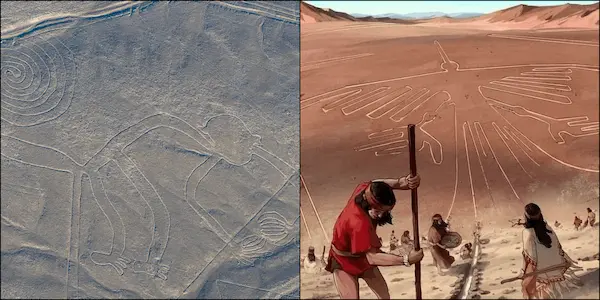
Despite their massive scale, the Images of Nazca Lines were created using simple tools. Archaeological findings reveal the use of wooden stakes and cords to outline figures, followed by the removal of the dark topsoil to expose lighter sediment below.
This method, combined with the region’s lack of rain and wind, allowed the designs to remain visible for centuries with minimal erosion.
Why aerial views reveal their true meaning
One of the defining characteristics of the Images of Nazca Lines is that they are not fully recognizable from the ground. Their scale demands a different perspective.
Perspective and elevation
From the air, fragmented lines turn into birds, animals, and geometric compositions. Hills near the plateau may have offered limited vantage points, but modern aviation has made it possible to appreciate the complete design.
Aerial observation brings clarity to spatial relationships between figures, something that is impossible to perceive while standing at ground level among the lines.
Modern aerial documentation
High-resolution aerial photography has transformed the study of the Images of Nazca Lines. Researchers can now track changes over time, discover new figures, and identify patterns that suggest ritual or astronomical alignment.
This technology has become essential for conservation, helping authorities protect a site that remains vulnerable to human activity.
Most recognizable figures and symbols
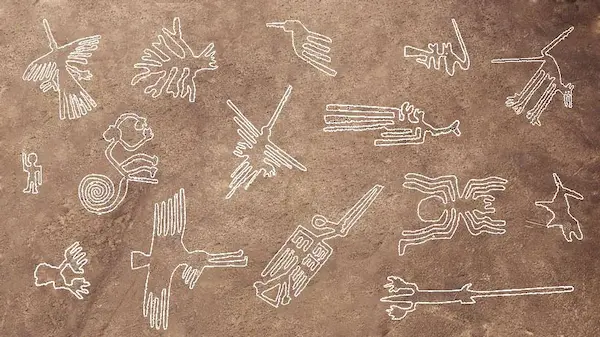
Among the hundreds of geoglyphs, several Images of Nazca Lines are especially prominent due to their clarity and symbolic resonance.
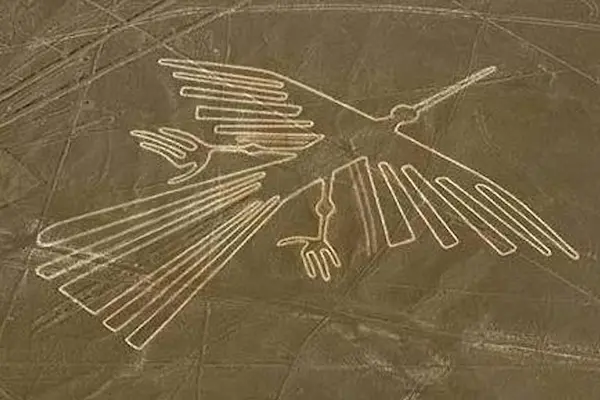
The hummingbird
Graceful and precise, the hummingbird is often cited as one of the finest examples of Nazca design. In Andean symbolism, hummingbirds represent renewal, balance, and spiritual communication—making this figure particularly significant within a ceremonial context.
The monkey
The monkey figure features a distinctive spiral tail and playful shape. Some scholars believe it reflects the Nazca people’s connection to distant ecosystems, including the Amazon rainforest, which was culturally important despite geographical separation.
The spider
Closely associated with water and fertility, the spider is believed to relate to rain rituals. In a desert environment, such symbolism reinforces theories that many Images of Nazca Lines were created as offerings to natural forces.
Lines and geometric shapes
Straight lines, trapezoids, and spirals dominate large portions of the desert. These formations may have served as processional paths where rituals took place, emphasizing movement and participation rather than observation.
Maybe you’ve been interested in: Discover the Best Route to Cusco: A Complete Guide for Your Journey Through the Andes
Interpreting the ancient secrets
The purpose behind the Images of Nazca Lines remains one of archaeology’s most enduring mysteries.
Astronomical theories
Some researchers suggest that certain lines align with solar events or star positions, functioning as a primitive astronomical map. While not all figures support this theory, selective alignments suggest intentional orientation.
Water-related rituals
Perhaps the most widely accepted explanation is that the Images of Nazca Lines played a role in rituals intended to summon rain. Their placement near underground water sources supports this interpretation.
Ceremonial use of space
Evidence of foot traffic along the lines indicates they were walked upon rather than merely admired. In this sense, the desert itself became a ceremonial stage, where movement was an act of devotion.
Experiencing the site today
Modern visitors have several options for discovering the Nazca geoglyphs while respecting their fragility.
Observation platforms
Viewing towers allow travelers to see a limited number of figures without disturbing the land. While not comprehensive, they offer a basic understanding of scale and design.
Scenic flights
Many travelers choose to explore the Nazca Desert as part of a broader regional experience that includes culture, nature, and history. Providers like Ica Tours help contextualize the Images of Nazca Lines within southern Peru, combining aerial perspectives with nearby coastal and desert attractions for a more complete understanding of the landscape.
For travelers looking to maximize their visit without rushing, itineraries such as Adventure in Ica and Paracas with Flight Over Nazca Lines 2 Days and 1 Night allow enough time to experience the geoglyphs from the air while also exploring the surrounding ecosystems, creating a balanced and immersive journey.
Cultural relevance and global recognition
The Images of Nazca Lines are recognized as a UNESCO World Heritage Site, reflecting their universal value to humanity. This designation highlights the need for careful preservation and mindful tourism practices.
Beyond archaeology, these geoglyphs have influenced art, popular culture, and academic discourse, continuing to inspire curiosity across disciplines.
Maybe you’ve been interested in: 9 Traditional dances of Peru
Conservation and responsible exploration
Choosing a certified Tour operator is essential when visiting the Nazca region, as responsible providers follow strict guidelines that protect the desert surface and ensure that tourism does not compromise the preservation of the geoglyphs.
Why the Nazca Lines still inspire the world
The Images of Nazca Lines remind us that ancient societies possessed advanced knowledge rooted in harmony with nature. Their creators shaped the landscape itself into a message—one that still speaks across centuries.
Rather than offering simple answers, these geoglyphs invite reflection on belief, environment, and the human impulse to leave meaning behind.
The lasting legacy of the Nazca Lines
Etched into the ground by ancient civilizations, the images of Nazca Lines represent an enduring form of artwork and a symbol of both environmental respect and a community’s desire to create meaningful works of art. The Nazca Lines have evolved into an international conspiracy of intrigue for many people around the world.
Today, when looking down on the Nazca Lines from an aerial perspective, we see a more expansive and intricate view than what was once possible. Geoglyphs allow for a continued dialogue between ancient people and their descendants today; thus, the continued interest in these sites invites us all to honour the legacies of our ancestors and encourages our desire to learn more about ourselves as human beings.